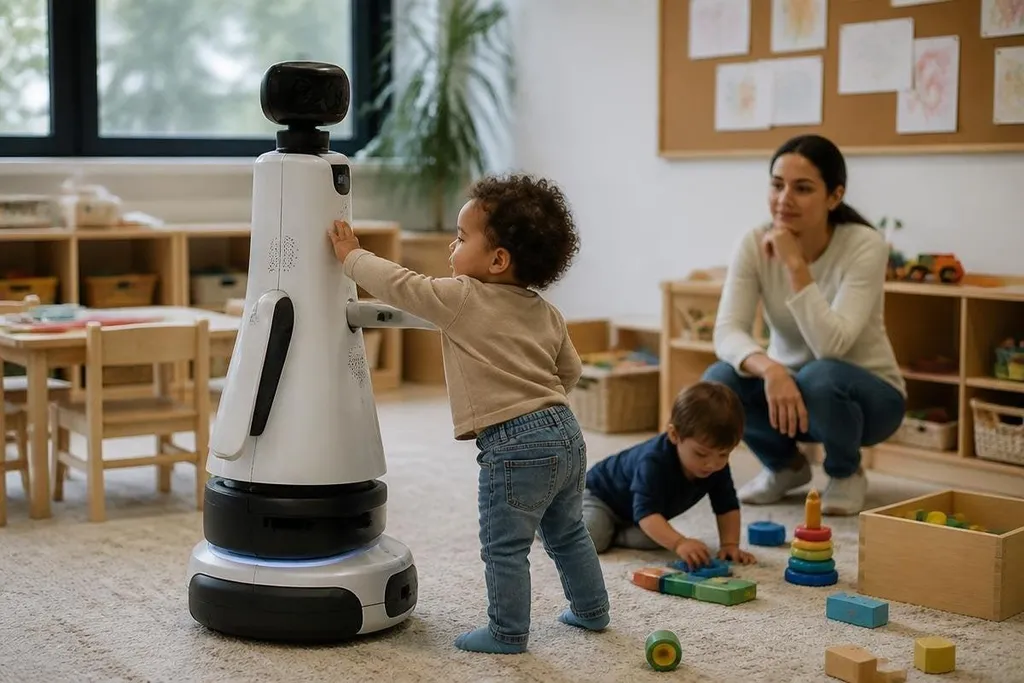
A childcare robot would work around children who move without warning, touch everything, and cannot judge danger well. That makes safety, privacy, and adult control more important than a soft voice or a smiling screen.
If you’re assessing this kind of robot, the useful question is simple: what can it do safely when a child behaves in an unexpected way?
- Safety comes first: The robot must detect people, furniture, toys, and sudden movement before it moves.
- Adult control matters: A parent or carer needs a clear way to stop the robot and check what it has done.
- Child data needs limits: Cameras, microphones, and stored records should have a clear purpose and a short retention period.
What the robot would need to do
A childcare robot could read stories, lead songs, answer basic questions, remind a child about a routine, or call an adult. Those tasks need different levels of control. Reading a story is low risk. Moving near a child, handling an object, or responding to distress is not.
The robot would also need to tell the difference between a planned task and a safety problem. A child hiding behind a chair, dropping a toy in its path, or reaching toward a moving arm should make the robot stop and ask for adult help. That response matters more than how naturally the robot speaks.
Speech recognition creates another limit. Young children may speak softly, change words halfway through a sentence, or give instructions that make no sense. A system that acts on every command could open a door, move an object, or contact someone at the wrong time.
The safer design is to keep actions narrow and require adult approval for anything beyond conversation.
The adult must stay in control
Childcare robots should support a carer rather than replace one. An adult needs to see when the robot is active, what sensors are running, and why it took an action. The stop control should be physical, easy to find, and usable while carrying a child.
Remote access needs the same care. A parent may want a phone alert when a child leaves a safe area, but a camera feed can expose private parts of a home or classroom. Robot makers need to explain who can view that feed, where recordings are stored, and how an account gets closed.
Privacy rules matter when the robot’s full response is tested. A childcare robot may need to react when a child leaves a safe area or an adult closes an account. Childcare robot reporting from Robot24.com can place those test results beside the machine’s limits as the next section looks at what remains unproven.
What remains unproven
A robot can repeat a task in a prepared room and still struggle in a busy home. Toys change the floor plan. Lighting changes what cameras can see. Several children can speak at once. A demonstration that avoids those conditions says little about daily care.
Emotional responses need careful limits too. A robot may detect a loud voice or a crying sound, but that does not mean it understands fear, pain, or conflict. It should alert an adult instead of presenting a guess as fact.
The price also cannot be judged from the robot alone. Families and care providers would need to pay for installation, software, repairs, updates, and any remote service. If a robot needs regular adult supervision, that time belongs in the cost.
A buying and trial checklist
Use this list before allowing a childcare robot near a child:
- Ask which tasks the robot can perform without adult approval.
- Test the stop control while the robot is moving.
- Check how it reacts to a child entering its path.
- Read the camera, microphone, storage, and account rules.
- Ask how the maker handles software faults and security reports.
- Run a trial in the real room, with normal noise, lighting, toys, and movement.
I'd wait for clear test results in real childcare settings before trusting a robot with unsupervised care. A useful next step is a public record of failed stops, missed speech, false alerts, and data handling, because those details will decide if these machines belong near children.